 CASA PAI ROGERIOCarapicuíba/SP
Oxum: meaning, history and traditions in Umbanda and Candomblé
Orixá of fresh waters, beauty, love, fertility and precious metals.
Who Oxum is
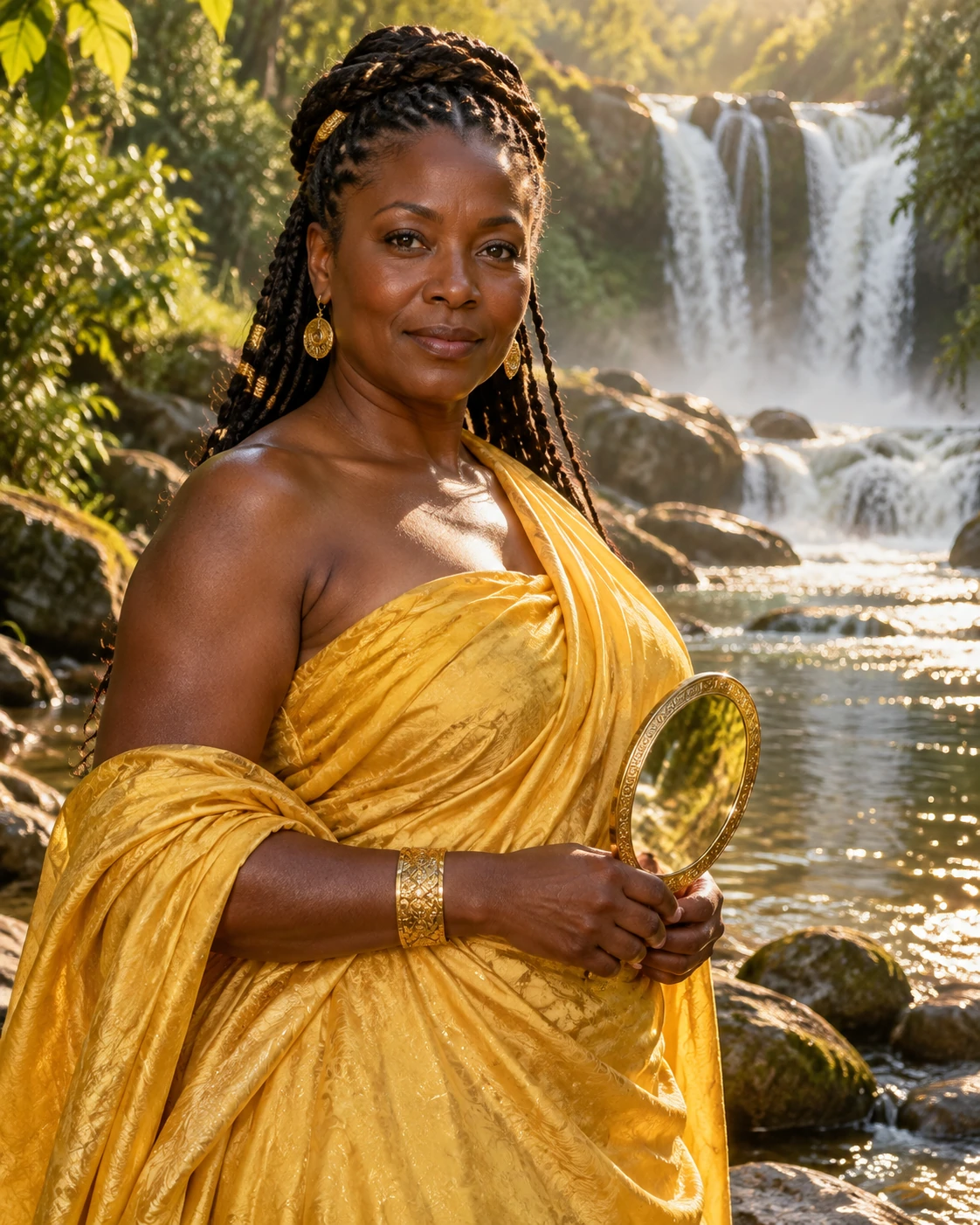
Belief / interpretationOxum reigns in rivers and waterfalls and is associated with beauty, sensitivity, fertility and feminine strength. She is frequently represented as an elegant woman, adorned with gold, with a mirror and fan.
Documented historyThe worship is of Yoruba origin and spread through the Americas. In Brazil, she is venerated in Candomblé and Umbanda, and is often recalled in broader cultural contexts, such as music and literature.
Teaching of a house or traditionSome houses associate Oxum with specific waterfalls, others with a day and a color. These details vary and are not a universal rule.
Mythic relationships
Traditional narrativeIn the narratives, Oxum appears as Xangô's wife and, in some versions, is also connected with Oxóssi and Ogum. She is Logun-Edé's mother in many stories.
Oxum and participation in creation
Traditional narrativeIn one version of the Ifá tradition, Oxum is one of the primordial deities, but her companions exclude her from decisions about the world because she is a woman. The other sixteen cannot fully accomplish their tasks and seek Olodumarê.
Traditional narrativeThe creator guides them to include Oxum: her strength is as necessary as theirs. The order of the world cannot be completed when part of that strength is left out. The version connects Oxum's presence with fecundity and the management of creation.
Belief / interpretationOne possible reading is that balance depends on participation and respect, not exclusion. This is an editorial interpretation of the story. Fertility, in this religious context, is not a guarantee of pregnancy nor a substitute for health evaluation. The source also publishes ritual guidance and healing claims that were not adopted by this site.
One interpretation in Umbanda Sagrada
Teaching of a house or traditionAn Umbanda Sagrada organization presents this Orixá, associating it with love and aggregation. This is one tradition's interpretation, not a confirmed foundation of CASA PAI ROGERIO. It should not replace Yoruba narratives or be treated as a universal correspondence.
Belief / interpretationThe source page also presents colors, stones and herbs of its tradition. We do not reproduce them as a table of recipes. A plant's common name, religious association and safety of use are different questions; a correspondence does not authorize ingestion or healthcare treatment.
Traditional narrativeOxum and the drought
It is said that, during a great drought, all the Orixás tried in vain to obtain rain from Olodumarê. Oxum volunteered, was ridiculed for being considered fragile, and transformed herself into a peacock. She flew so high that the heat burned her feathers until they turned dark. She arrived before Olodumarê, who was moved by the sacrifice and sent the rain. The narrative speaks of persistence and courage in adversity.
Narrative retold in summary, in the site's own words. Variations exist among houses and traditions; the bibliographic attribution, when available, appears at the end of the page.
Frequently asked questions
Is Oxum only beauty and money?
No. The narratives also show her determination, her ability to solve what others could not, and her connection with fertility and the waters that give life.
Is Oxum Our Lady?
There are syncretic identifications with several invocations of Mary, which vary by region. It is not a doctrinal equivalence.
Bibliographic references
- PRANDI, Reginaldo. Mitologia dos orixás. São Paulo: Companhia das Letras, 2001.
- VERGER, Pierre Fatumbi. Orixás. Salvador: Corrupio, 1997 (work cited in the sources consulted; consult the edition of your choice).