 CASA PAI ROGERIOCarapicuíba/SP
Pretos-velhos and pretas-velhas: ancestry, wisdom and memory
Line of spirits who present themselves as elders of African origin, connected with the memory of slavery and charity.
Who they are
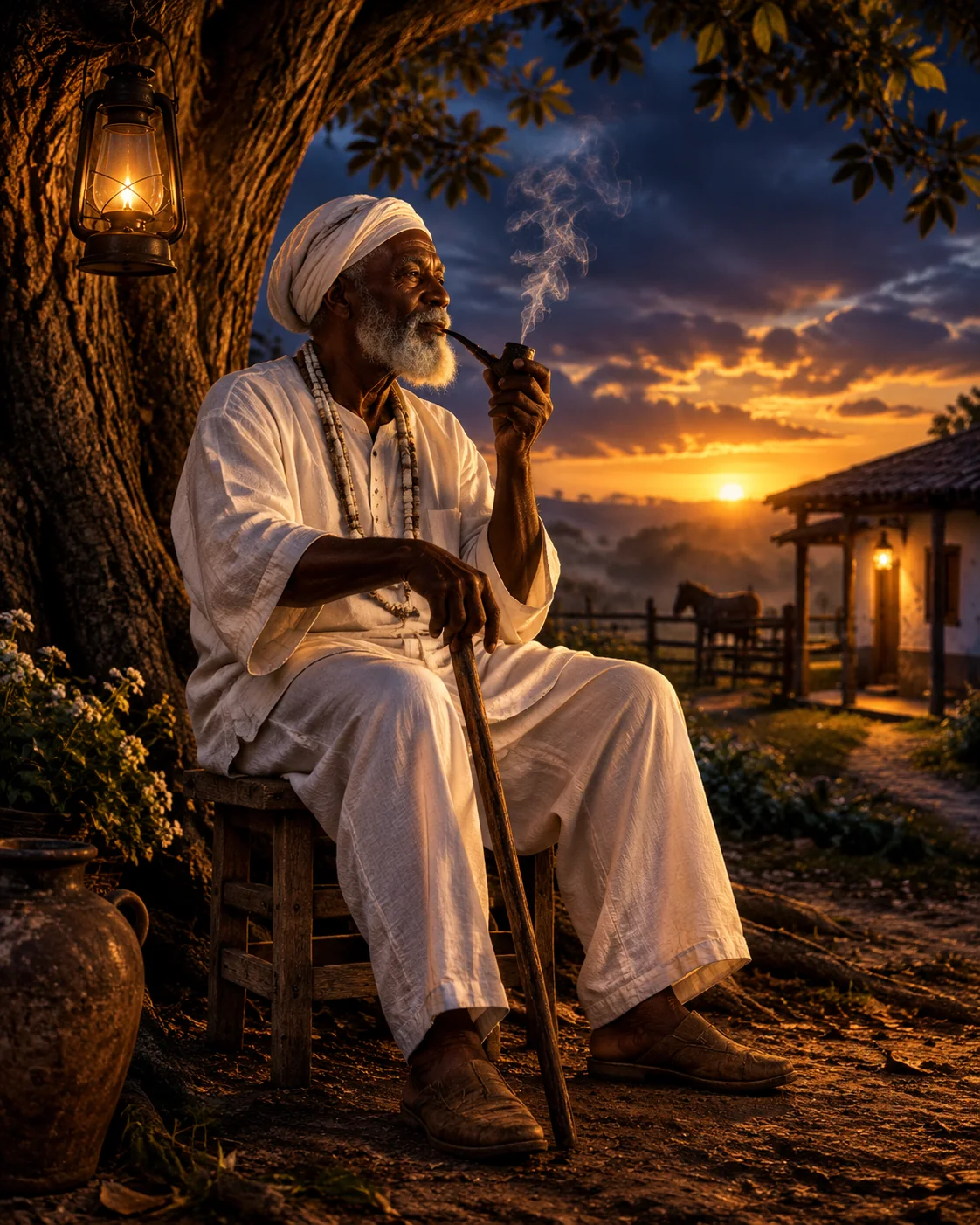
Teaching of a house or traditionPretos-velhos present themselves through the archetype of elderly Africans who lived in slave quarters. Sources describe them as wise, tender and patient, offering love, faith and hope. They are recognized nationwide as one of the best-known lines.
Teaching of a house or traditionBarros observes that the preto-velho's "mystique" arises from conditions unique to Brazil. For those who receive these guides, they are marked by simplicity, tolerance and a deep sense of charity, having learned to respond to violence with love, without a desire for revenge.
Teaching of a house or traditionAccording to the literature consulted, they commonly smoke pipes, give blessings with sprigs of rue, pray with rosaries and sprinkle water. In many houses, puffs of smoke are understood as cleansing and harmonization. This is a house custom, not a general rule.
Dates and names
Teaching of a house or traditionIn many Umbanda houses, pretos-velhos are honored on May 13, the date of the Lei Áurea. Common names cited in popular sources include Pai João, Pai Benedito, Vovó Maria Conga and Mãe Cambina (also spelled Vovó Cambinda). Identical names do not imply a single biography, and the site does not invent life stories for these guides.
Teaching of a house or traditionSome bynames indicate origin or line of activity (do Congo, de Angola, de Aruanda, das Matas, das Almas), with associations with Orixás that vary by house.
Memory and respect
Documented historyThe presence of pretos-velhos keeps the memory of enslaved people alive and recalls the violence of captivity and the recognition of African ancestry. Speaking of them requires respect for the history of slavery and the racism that still accompanies it.
Ancestry and differences in presentation
Teaching of a house or traditionOne tradition's memory describes a guide recognized as a friend and adviser, demanding ethics and attentiveness from mediums. The account belongs to the relationship between that medium and the spirit in that house, without proving a civil biography or establishing a universal identity for guides with the same name.
Teaching of a house or traditionAngola, Congo or Guinea appear in the source as references in guide names. Forms of address such as pai, mãe, tia and avó express welcome and respect. A religious name may preserve memory and a context of spiritual work, but is not enough to reconstruct a historical life.
Documented historyThe violence of slavery should not be softened to beautify a narrative. Respect for ancestral wisdom does not turn imposed suffering into a desirable destiny or justify racism.
Frequently asked questions
Is a preto-velho the spirit of a specific person?
In general, sources treat them as ancestral archetypes, not as historically identifiable people.
Bibliographic references
- BARROS, Sulivan Charles. As entidades "brasileiras" da Umbanda e as faces inconfessas do Brasil. Anais do XXVII Simpósio Nacional de História (ANPUH), 2013.